
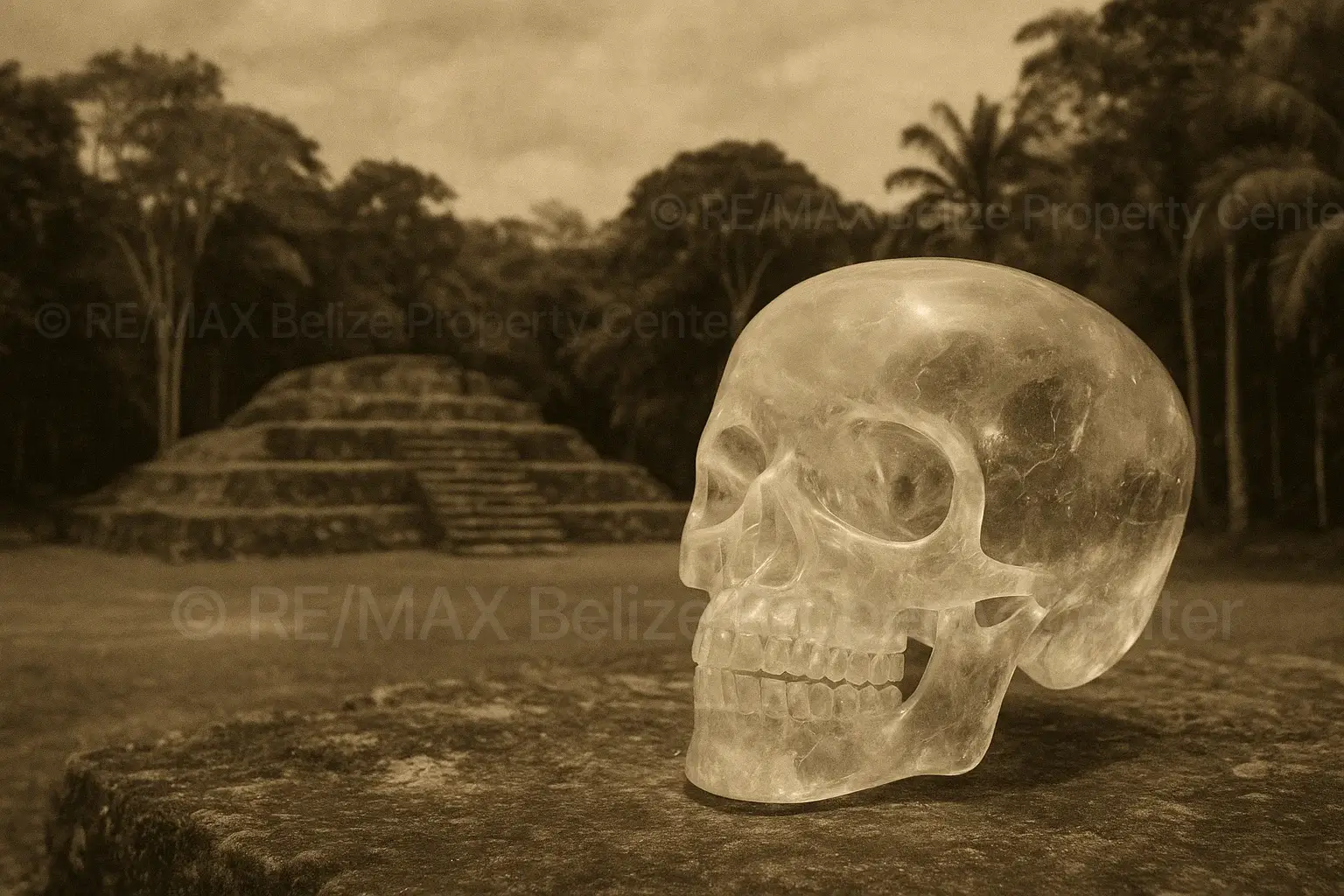
The Magic and Mystery Woven into Belize
Part of the allure of Belize is that it’s a country steeped in legend. When you explore its ancient ruins and lush jungles, you are connecting with a history filled with enigmatic stories. Perhaps none is more famous, or more controversial, than the tale of the Mitchell-Hedges Crystal Skull, a real-life mystery that rivals any Hollywood adventure.
The Lost City of Lubaantun
In the foothills of the Maya Mountains in southern Belize lies Lubaantun, the “place of fallen stones.” This Late Classic ceremonial hub, occupied from 730 A.D. to 890 A.D., is known for its unique style of stone architecture, built without mortar.
The legend begins here in 1924, during an expedition led by British adventurer Frederick Albert Mitchell-Hedges. According to his adopted daughter, Anna, it was she who discovered the skull under a collapsed altar on her 17th birthday. Three months later, the detachable jaw was supposedly found nearby. This discovery would spark a mystery that endures to this day.
The “Skull of Doom”: An Object of Power?
In Mayan culture, the skull was a sacred symbol of power. Mitchell-Hedges himself fueled the object’s mythology, calling it the “Skull of Doom” and claiming it was used by Mayan high priests to “will death.”
The skull itself is an anatomical marvel. Carved from a single block of clear quartz crystal, it weighs 11.7 pounds and is a near-perfect replica of a small human cranium. For decades, its owner, Anna Mitchell-Hedges, claimed it had supernatural powers, alleging it would turn cloudy to foretell tragedies, such as the JFK assassination.
A Scientific Enigma: The Hewlett-Packard Findings
In 1970, the mystery deepened. Anna submitted the skull for analysis at Hewlett-Packard Laboratories, a leading technology research center. The findings were astonishing:
- Carved Against the Axis: Researchers determined the skull was carved against the natural axis of the crystal, an act that, by the laws of physics, should have caused it to shatter, even with modern laser technology.
- No Tool Marks: The analysis could not find any microscopic scratches on the crystal’s surface, leaving no evidence that it was carved with metal tools.
Art restoration expert Frank Dorland, who oversaw the tests, could only hypothesize that it was painstakingly hand-carved and then polished with a silicon-and-water solution over a period of 300 years. This seemingly impossible feat led many to speculate about its origins, with theories ranging from a lost, technologically advanced civilization like Atlantis to extraterrestrials.
The Controversy: A Tale of Skullduggery?
While the legend is compelling, the official history is murky and full of contradictions.
- There are no photographs of Anna or the skull from the 1924 Lubaantun expedition.
- Unearthed records show that Mitchell-Hedges actually bought the skull at a Sotheby’s auction in London in 1943 for £400 from a dealer named Sydney Burney.
- Mitchell-Hedges was a known adventurer and showman, a card shark who fought with Pancho Villa and loved to spin a tall tale. In his own autobiography, he cryptically wrote, “How it came into my possession I have reason for not revealing.”
From Ancient Mystery to Modern Adventure
Was the Crystal Skull a 3,600-year-old Maya artifact imbued with mystical powers? Or was it a masterfully crafted 19th-century piece that an English adventurer used to build his own legend?
Only the skull knows for sure.
Today, the legend is a vibrant part of Belize’s rich cultural tapestry. It adds a layer of magic to the tangible history you can explore with your own eyes. When you visit the Toledo District and walk through the silent stones of Lubaantun, you are not just seeing ruins; you are connecting with these incredible stories that make Belize a truly unique place to live and explore.
Ready to find your own piece of Belizean history and adventure? Contact our team of local experts to explore properties in the Toledo District and beyond.